SPACE & COSMOS | GALACTIC BAZAAR
The universe has a peculiar habit of refusing to follow our expectations.
Galaxies are supposed to be recognizable. Some spiral gracefully around luminous centers. Others form enormous elliptical clouds of stars. Even when galaxies collide, astronomers generally recognize the gravitational forces responsible for their spectacular distortions.
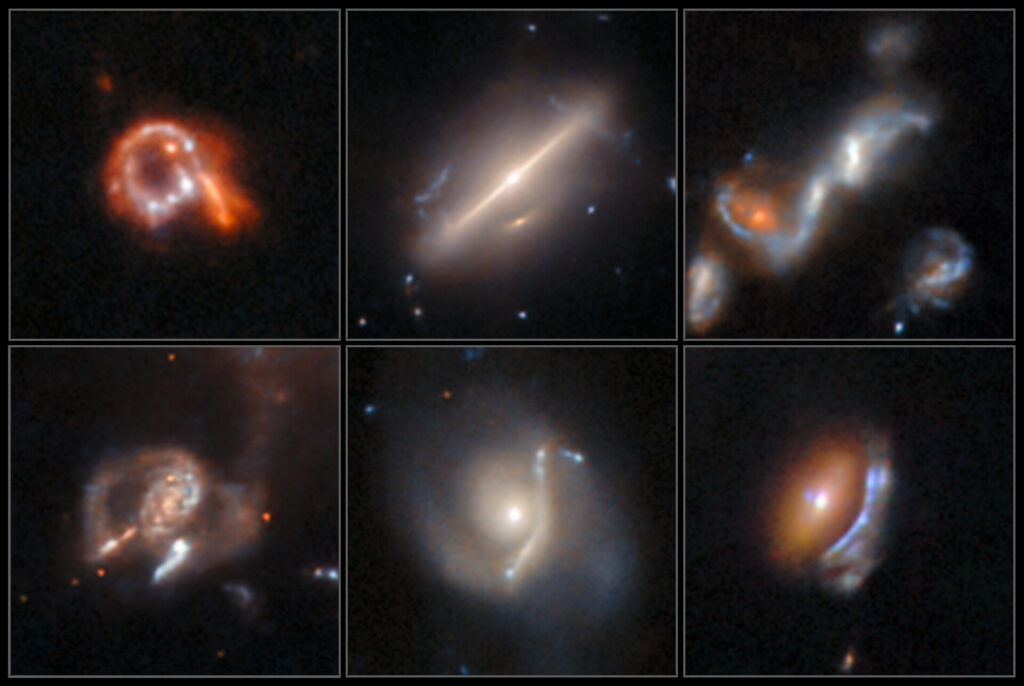
But hidden inside decades of images captured by the Hubble Space Telescope were objects that didn’t quite fit the familiar categories.
Some appeared stretched into impossible-looking arcs. Others formed nearly perfect rings. One resembled a strange butterfly with a swirling center and two enormous lobes.
The images had been sitting in an astronomical archive, waiting to be noticed.
And it took artificial intelligence to bring many of them to light.
A Cosmic Treasure Hunt
In January 2026, the European Space Agency announced the results of an extraordinary search through the Hubble Legacy Archive, a collection containing decades of observations from one of humanity’s most productive scientific instruments.
Researchers David O’Ryan and Pablo Gómez developed an artificial intelligence system called AnomalyMatch, designed to identify objects that look different from their astronomical neighbors.
Rather than searching for one specific kind of galaxy, the system helped researchers hunt for the unexpected.
It examined approximately 99.6 million small image cutouts in just two and a half days.
The results were remarkable.
The researchers identified more than 1,300 unusual astronomical objects, including more than 800 that had not previously been documented in scientific literature.
Among the discoveries were colliding galaxies, gravitational lenses, ring galaxies, and objects that resisted straightforward classification.
The telescope hadn’t suddenly discovered a new part of the universe. Many of these objects were already in the archive.
What changed was our ability to find them.
When Galaxies Bend Reality
Some of the most visually striking discoveries demonstrate a phenomenon predicted by Albert Einstein: gravitational lensing.
Massive objects can distort the fabric of spacetime, bending the light traveling from more distant galaxies behind them.
The result can look like an optical illusion.
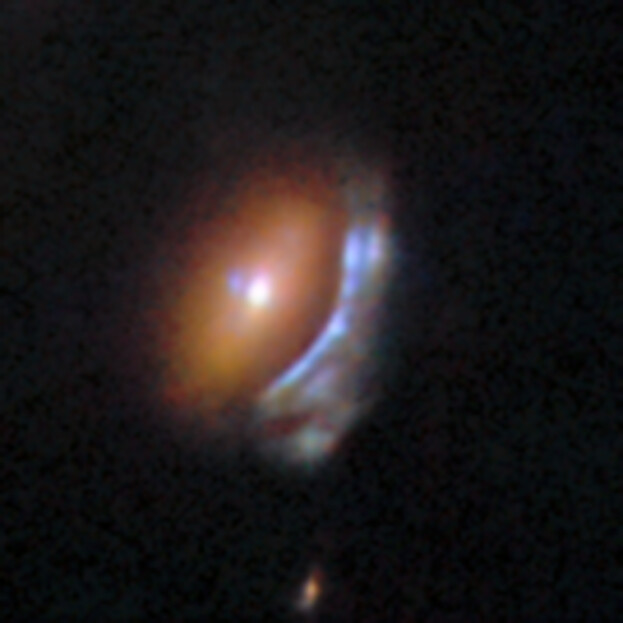
A normal spiral galaxy might appear stretched into a curved blue ribbon. Light from a distant object may form an arc or even an apparent ring around a closer galaxy.
These aren’t physical galaxies twisted into those particular shapes. They are distorted images produced by gravity itself.
In one Hubble image highlighted by ESA, a reddish elliptical galaxy sits beside a brilliant blue arc—the warped image of a spiral galaxy much farther away.
The universe has effectively created its own magnifying glass.
For astronomers, such objects are more than visual curiosities. Gravitational lenses provide opportunities to study distant galaxies and investigate how matter is distributed throughout the cosmos.
The Galaxy Without a Clear Identity
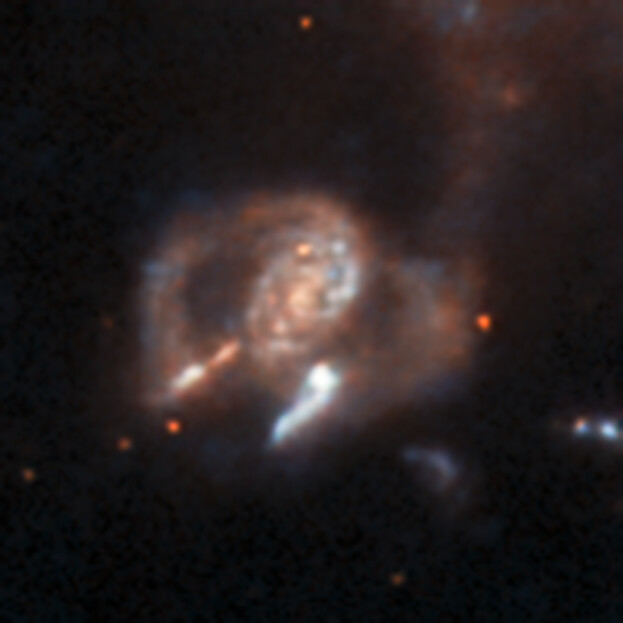
Perhaps the most intriguing image from the search shows an object with a compact, swirling core surrounded by two enormous curved lobes.
ESA describes it as an unusual bipolar galaxy whose precise classification remains unclear.
It is an extraordinary sight, almost resembling a celestial insect with its wings spread wide.
Yet its appearance is not evidence of artificial construction or some violation of physics. It is a reminder that the universe contains structures whose histories are difficult to reconstruct from the information currently available.
Other anomalies include galaxies with long tidal tails produced by gravitational interactions, systems undergoing violent mergers, and rare ring-shaped galaxies associated with cosmic collisions.
The strange shapes are real. Their explanations range from well-understood physical processes to cases requiring further investigation.
That distinction is important.
An anomaly isn't necessarily something science cannot explain. Sometimes it is simply something scientists haven't had the opportunity to study.
The Next Great Discovery May Already Exist
Hubble began observing the universe in 1990. Its enormous archive has become a scientific resource that continues to produce discoveries long after the original observations were recorded.
But the quantity of astronomical data is growing far beyond what researchers can reasonably examine by hand.
New observatories, including the European Space Agency’s Euclid mission and NASA’s Nancy Grace Roman Space Telescope, are designed to survey vast regions of the sky.
Their observations will produce enormous collections of images—and potentially countless objects that don’t quite fit existing classifications.
Tools such as AnomalyMatch could help astronomers identify the rare and extraordinary amid billions of otherwise familiar sources.
The implications extend beyond finding beautiful pictures.
Unusual objects can reveal overlooked physical processes, provide new targets for detailed observations, and challenge existing models of how galaxies form and evolve.
Artificial intelligence isn’t replacing the astronomer’s judgment. In this study, human researchers still examined and classified the most promising results.
Instead, AI is becoming something like a cosmic research assistant, tirelessly scanning astronomical records for details that deserve a closer look.
And that raises a fascinating possibility.
Some of the next great discoveries in astronomy may not require a new telescope, a distant spacecraft, or an expedition into unexplored space.
They may already be sitting on a hard drive, waiting for someone—or something—to recognize just how strange they are.
Based on O'Ryan and Gómez, Astronomy & Astrophysics, Vol. 704, A227 (2025), and ESA's public release dated January 27, 2026. The headline is editorial framing; these galaxies do not contradict known physics.