FUTURE & TECHNOLOGY | GALACTIC BAZAAR
Far below, an ocean may contain the ingredients necessary for life.
It sounds like a scene from a science-fiction movie. But the robot is real.
At NASA’s Jet Propulsion Laboratory in Southern California, engineers have been developing a remarkable machine called EELS — the Exobiology Extant Life Surveyor.
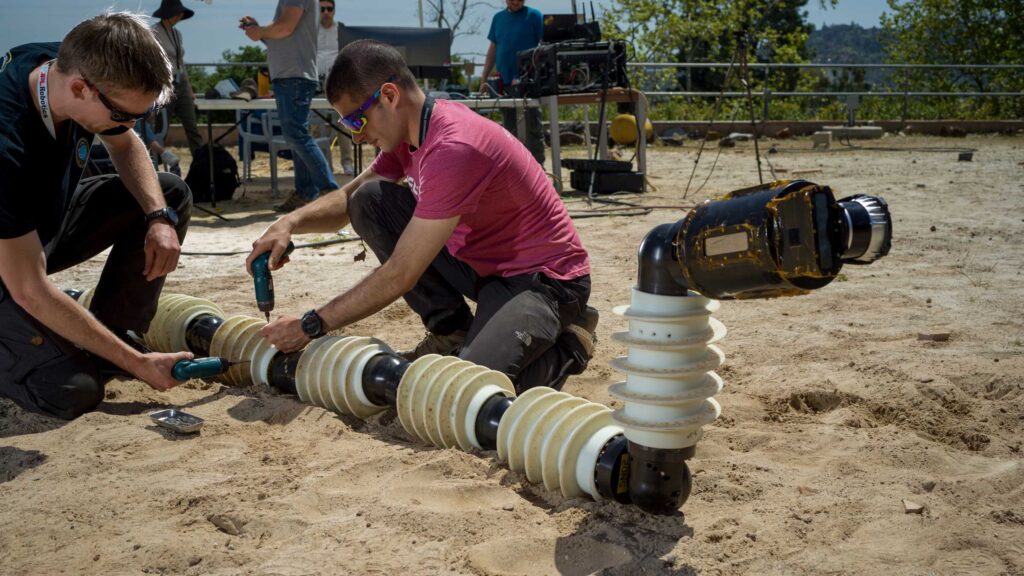
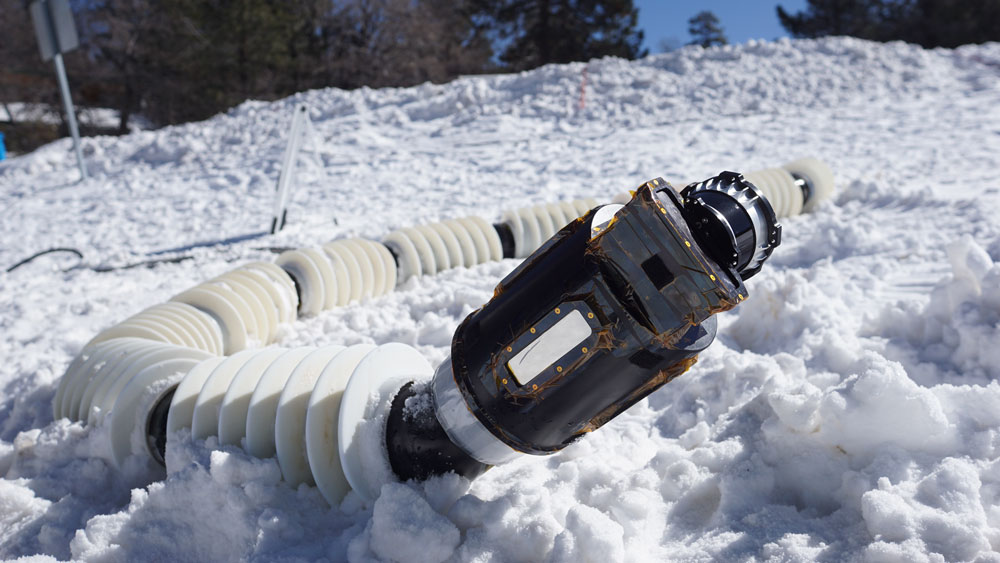
Unlike the wheeled rovers exploring Mars, this robot moves by twisting and turning its segmented body. Its cylindrical sections use rotating screws to grip ice, push through snow, and navigate difficult terrain.
The technology was inspired by one of the most intriguing destinations in our solar system: Enceladus, a small moon of Saturn that conceals a liquid-water ocean beneath its icy surface.
And although EELS has never traveled beyond Earth, its strange design hints at how future robots might venture into places previously considered inaccessible.
01 / Why Build a Robotic Snake?
Traditional planetary rovers are extraordinary machines, but they have limitations. Wheels work well on relatively open terrain. They are much less useful inside narrow cracks, vertical shafts, or unpredictable underground passages.
Enceladus presents precisely those challenges.
NASA’s Cassini spacecraft discovered enormous plumes of water vapor and ice particles erupting from fractures near the moon’s south pole. These plumes originate from material associated with the ocean hidden beneath the frozen exterior.
Scientists are interested in that ocean because it contains water, organic compounds, and evidence of chemical processes that could potentially support life.
But studying the ocean directly would be exceptionally difficult.
An exploration system might need to negotiate irregular openings, descend through shifting ice, and navigate without immediate instructions from Earth.
EELS was conceived as one possible technological answer.
Rather than forcing an ordinary rover into extraordinary terrain, its designers borrowed a solution from nature: the flexible body of a snake.
02 / How EELS Moves Without Wheels
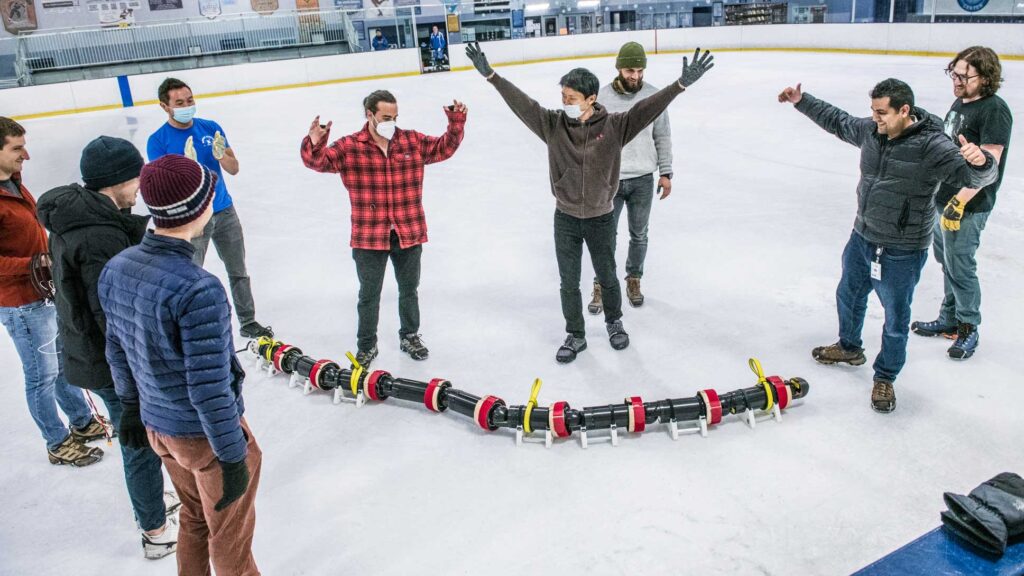
The EELS 1.0 prototype described by JPL in 2023 measured approximately 13 feet long and weighed about 220 pounds.
Its body consisted of ten articulated segments equipped with rotating, screw-shaped propulsion mechanisms.
Imagine several oversized corkscrews connected end to end.
By changing how its individual sections rotate and bend, the robot can produce different movements for different surfaces.
On loose snow or sand, broad plastic screws provide traction. For harder ice, engineers experimented with sharper metal versions.
The machine’s greatest advantage may be its ability to change shape.
It can curve around obstacles, raise its sensor-equipped head, and potentially brace itself against opposing walls while moving through narrow passages.
But movement is only part of the problem.
EELS is also being developed to make decisions independently. Cameras and lidar sensors generate three-dimensional maps of its surroundings, while navigation software evaluates possible routes and hazards.
That autonomy would be crucial on another world, where radio signals take too long to support continuous remote control.
A robotic explorer descending into an alien crevasse cannot depend on someone back on Earth telling it when to turn left.
It must learn to navigate uncertainty.
03 / Testing an Alien Explorer on Earth
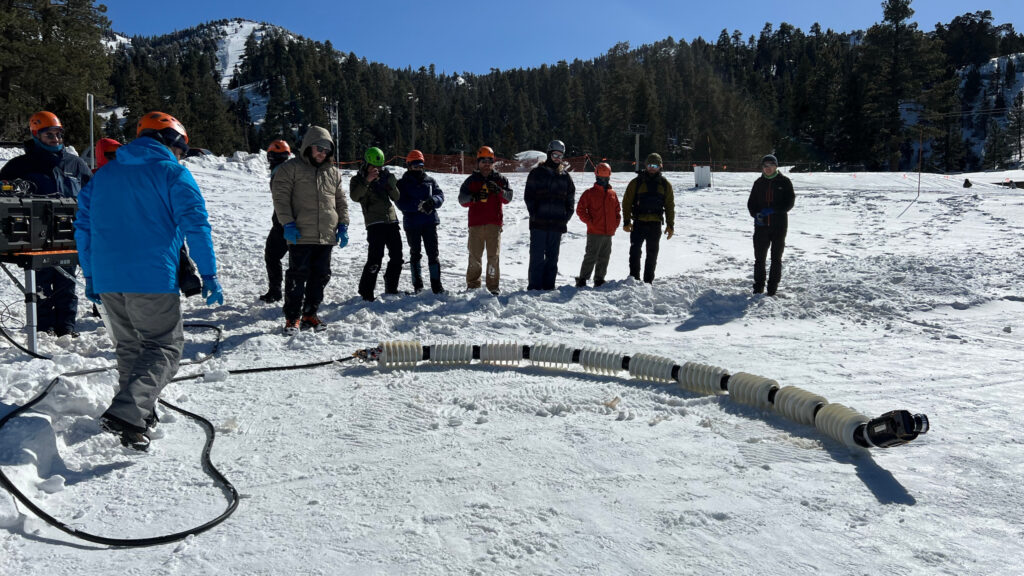
Before a robot can venture beneath extraterrestrial ice, it has to prove itself in difficult environments here on Earth.
NASA engineers began building EELS prototypes in 2019. They subsequently tested the unusual machine at JPL’s simulated Martian terrain facility, an indoor ice rink, and a snowy mountain resort in Southern California.
The experiments challenged the robot to move across sand, snow, and ice while engineers adjusted its mechanical design and software.
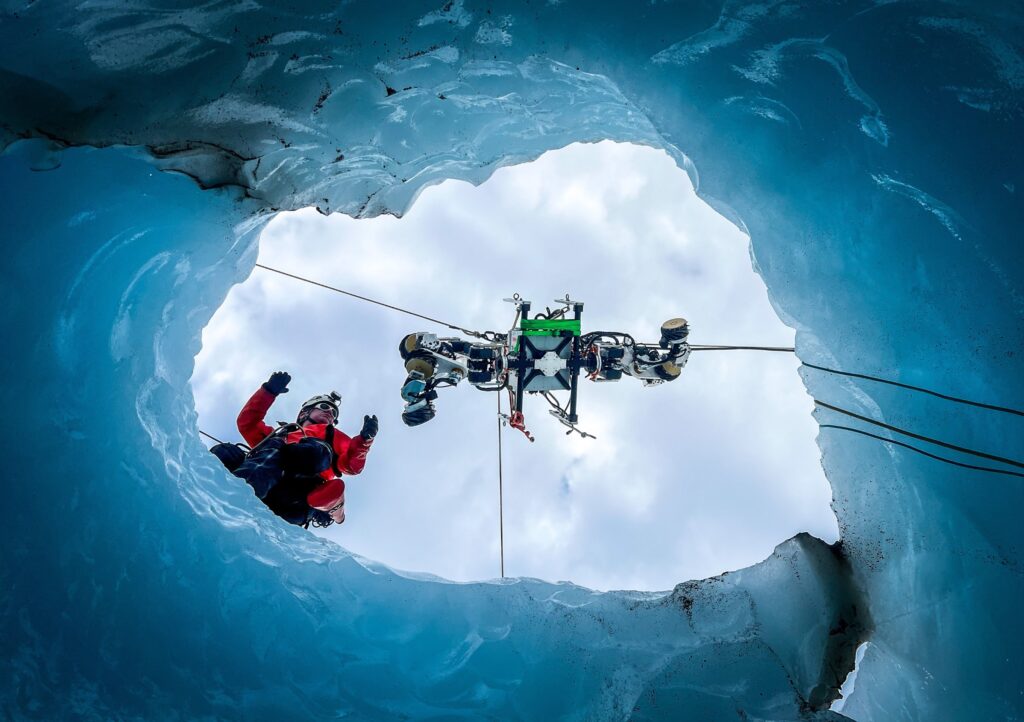
One particularly ambitious testing location was Athabasca Glacier in the Canadian Rockies.
In 2022, researchers lowered an EELS sensor head into a vertical glacial shaft, known as a moulin. Later fieldwork in 2023 involved additional robot prototypes, including versions designed to investigate subsurface navigation.
These natural ice formations provided opportunities to confront some of the unpredictable conditions an extraterrestrial robot might encounter.
Real glaciers have irregular surfaces, hidden cavities, and complex internal structures. They are far less forgiving than a controlled laboratory.
The work also illustrates how planetary exploration technology can have applications closer to home, including studying glaciers, caves, and hazardous environments too difficult for humans or conventional robots to investigate safely.
04 / The Search for Life Beneath Alien Ice
Enceladus remains one of the most compelling locations in the search for extraterrestrial life.
Its ocean is shielded from space by a shell of ice, and Cassini’s observations revealed chemical evidence suggesting interactions between water and rock deep inside the moon.
Those conditions make it an intriguing place to investigate habitability.
However, a promising environment is not the same as evidence of living organisms. No life has been discovered on Enceladus.
And EELS is not currently scheduled to go there.
The robotic snake is a technology-development effort, intended to investigate mobility and autonomous navigation techniques that could eventually support future exploration.
Significant challenges remain, including reliability, access to the subsurface, and the scientific instruments required to analyze potential biological signatures.
Nevertheless, the concept offers a tantalizing glimpse of what planetary exploration could become.
For decades, robotic spacecraft have traveled across landscapes, drilled into rocks, and photographed distant worlds from orbit.
The next generation may need to go somewhere much more difficult.
Down.
Into fractures, caves, tunnels, and perhaps the hidden oceans of icy moons.
If humanity eventually discovers life beneath the frozen surface of another world, the first visitor might not resemble a conventional spacecraft.
It might look surprisingly like a snake.
Primary Sources, Photography & Further Reading
All photographs in this feature: Courtesy NASA/JPL-Caltech. Original imagery and project information: NASA/JPL EELS gallery. The robot remains a technology-development prototype, not an approved mission to Enceladus. JPL image-use policy.
- NASA/JPL — JPL’s Snake-Like EELS Slithers Into New Robotics Terrain (May 8, 2023).
- NASA/JPL — EELS Project Overview and Photo Gallery (official robotics project).
- JPL Robotics — EELS System Architecture (engineering details and design objectives).
- JPL Engineering Research — EELS Athabasca Glacier Field Tests (technical research and field observations).